

How to Write Content for SEO
How to write content for SEO
The SEOs Dilemma
As an SEO agency, one of the most common questions clients ask us is to produce SEO content that will rank organically online. However, most SEO writing professionals lack sufficient knowledge of the client’s business. For example, we might not have enough details about businesses like restaurants or artists. Yet we have to meet strict deadlines and produce in-depth content. So how would you write (or give instructions to write) meaningful content that is fit for purpose?
In this article, we share our SEO agency’s secrets in a step-by-step guide so that you, too, can write valuable content that will rank.
SEO, the short form for ‘Search Engine Optimisation’, is a fairly misunderstood topic. But once you know how to optimise your content, SEO writing becomes magical and enables you to rank and reach a larger audience. We will take you through the tips and tricks on how to create good quality content that could become an internet ‘hit’ online.
Your Time is Valuable
We find the most difficult issue for small businesses is time. Business owners must manage their businesses and keep up with daily demands. However, to be successful online, businesses need to create quality content that adds value – something the reader can take away for free. Some people call it ‘Unique Content’ where the reader is educated to make an informed decision or encouraged to take action.
The best way to obtain high-quality content is to have a content writer create the text and then perform the SEO writing afterwards. There are numerous copywriting firms and freelance writers available, offering a bewildering array of choices.
However, if you are starting your online journey afresh, this can be a rather costly process if you do not have contacts with copywriters. We advise you to talk to your SEO agency first, as they already have close connections with copywriters they trust. It could save you a fortune!
I don’t have the budget for a writer, so how to write SEO content for myself?
This is where we get into the nitty-gritty of SEO writing! Below is a step-by-step guide on how to write SEO friendly content like a pro.
Step 1: Choose a Title - Title Tag
First, select a topic. Having a clear idea about what you want to write about is essential. If you do not have any idea, think about what your customers might find useful, or what questions your customers mostly ask. For example, if you have a bike shop, take the topic 'bike safety'. This will also become your page title tag and your focus keyword or keyphrase.

Step 2: What are people searching for online - Search Intent
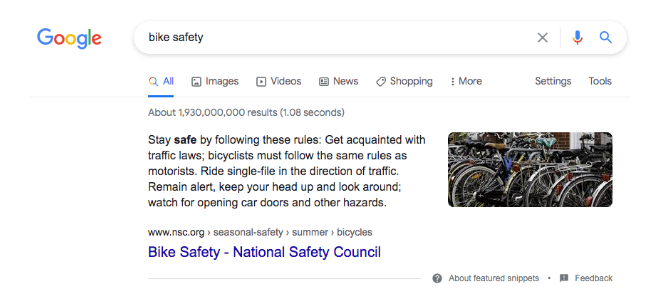
You then need to consider what people are searching for on Google related to the topic. Type in ‘bike safety’ on Google and see what results you get! This is called 'search intent'.

Step 3: Search Results - People Also Ask
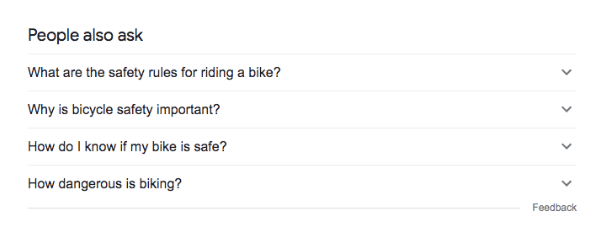
Since our topic is very generic, how do we know what people have in mind when searching for this phrase? The easiest way to find this out is by looking at the section 'people also ask’ on Google search. When you read those suggestions, you will have a better understanding of people’s queries, which in turn will help expand your content.
Search Engine | People Also Asked search result
Step 4: Choose an exciting topic - Mind Map
Scroll down the page and read all the suggestions and search results to make a mind map for your content. We researched ‘bike safety’, and we are now equipped to outline and expand on the topic by following the suggestions provided by 'People Also Ask' and other search results.
Remember your objective – you want to write a piece of content that could be an instant hit and rank highly. Be warned, mundane topics are unlikely to rank on the first page of Google!
Step 5: Create authoritative content - 'Citations'
Citations will add value to your content, so try to add them to make it more authoritative. It’s just like how we reference our work in college or university – except this is on a website. If you want to know more details about citations, visit: https://www.plagiarism.org/article/what-is-citation
Step 6 Position Zero - Featured Snippet
Read and analyse the text in the featured snippet section of the page as they provide short answers to certain relevant questions people ask on the topic. But what is a ‘snippet’?
A featured snippet is a short extract of text that shows at the top of Google search engine results to provide a prompt answer to people’s queries. This is also referred to as 'Position Zero' to SEO experts. The common types of featured snippets are definitions, lists, tables, and steps.
Once you have an understanding of what people search for, you can build on the phrase ‘bike safety’ and grow your content around the title tag.
How to further expand your content?
The featured snippet is not the complete answer, so you need to provide more detailed content on the topic. You can also benefit from NLP (natural language processing) technologies, which is a form of AI. It extracts the meaning of human languages to make decisions based on that information. It helps you expand and add value to your content.
www.dandelion.eu is a great free tool that can help you expand your topic area.
Coming back to our example topic, we can now expand the content by asking common (and important) questions like ‘why is bike safety important’? Readers might not know the technical jargon in the answer, so entity extraction is ideal to help you build on the content. Dandelion API will extract the meaning from unstructured text and put it into context with a simple API.
Create a Novel Research
When you write the article, make sure to research the topic thoroughly. You can follow
Google Trends to stay up to date with the latest information. The article needs to be accurate, rich in stats, and cite authoritative work from professionals.
Add practical examples like bike cameras in your article to make it more realistic and engaging for the reader. Additionally, include references and links to other sites where users can find authentic and detailed information.
OK, what’s next?
After you add the meat around the bones, revise the relevant content to keep readers engaged and focused on the point.
You will need to:
- Use the right terminology relevant to your topic – for example, ‘hand signals’ in bike safety.
- Use the actual language used in the topic area you are writing – do not create your own.
- Keep your content quality high. The Hemingway App is a straightforward and useful tool to help you craft high-quality content.
Once you have polished your content, let the world know that you have created this piece of writing backed by research. Always remember to put citations where necessary. You can search for citations online as Wikipedia is full of tons of citations. After a final review, send the article to your SEO specialist to optimise it and get it published.
Last step Meta Description
Write an enticing meta description and send this to your SEO agency.
A meta description is an HTML element that describes and summarises the contents of your page for the benefit of users and search engines.
Although the meta description is not a ranking factor, it sets the expectations for what users will see once they arrive at your article.