What is Schema Markup?

Peter • January 20, 2021

Schema Markup - What is it and how to add it to a website?

From an SEO marketing agency's perspective, Schema markup can be one of the most confusing components of the SEO world due to its inherently technical nature. It’s not something that can be seen on a webpage by visitors, nor is there an easy way to know if it’s working correctly once in place. Let’s try to demystify some of that today. 


Here is a summary of what schema markup is and how you can add it to your website:

  • Schema markup is microdata that makes it easier for search engines, crawlers and browsers to understand what is on a webpage 
  • There are 1000s of types of schema markup designed to represent different kinds of ‘things’ (including individual nouns and verbs) that may be searched for online
  • Implementing schema effectively requires 4 steps: 
  • Understanding of the type of data you can represent on a webpage 
  • Using a tool to generate the schema markup 
  • Embedding the schema markup on a specific page
  • Testing it with the Google or Bing structured data testing tool


Now let’s dive in...


What is Schema markup?


Schema markup, as it’s used today on the web, enables robots that crawl your website to more easily understand the content on the page in a language that makes sense to them. Schema does this by giving a structured way for robots/crawlers to define the types of information and data present on the page.


When a robot (like Google) crawls your website, they have a hard time understanding the content within the webpage. This is because of the way websites are designed and built today. This may come as a surprise to some, but HTML and CSS actually make for a very unstructured system. However, this makes sense if you think about it — designed websites are built for humans and not for robots. 


Schema is an open-source initiative by the web community to help define commonly represented things with a structured, predictable system. You can read the many types of schema at
schema.org. Now, I would not recommend you spend time on schema.org. The website is confusing and you’ll quickly get lost in it, or just get bored and leave. 


What Schema markup should you use? 


There are 1000s of different types of schema that exist on the schema.org website. One common misconception about schema is that it’s intended to represent everything that could be searched for on the web — but this is not true. Schema.org aims to provide a structured way of representing the most common things used or searched for on the web. 


One point of clarification: when people use the term ‘things’ in relation to schema, they are referring to types of information that schema looks to represent. These can be nouns (people, places, or things) or verbs (actions). As an example, a schema can represent a hospital or a travel agency. Or It can represent an action, like listening to a podcast. It’s confusing, and honestly, I think most people should ignore all that complexity and different types of schema that exist. 


Additionally, I strongly recommend that any website agency or developer only use schema where it has an impact. Today, that only means influencing search engines like Google and Bing. Both Google and Bing understand & read schema. They use it to be sure they understand the content on the page and then they use that certainty to display special features on the search results page.


An example of this is events. You can use schema to inform Google and Bing of upcoming events. Once they have certainty about the information, they can present those events directly in the search results page. Here’s an example from Google:
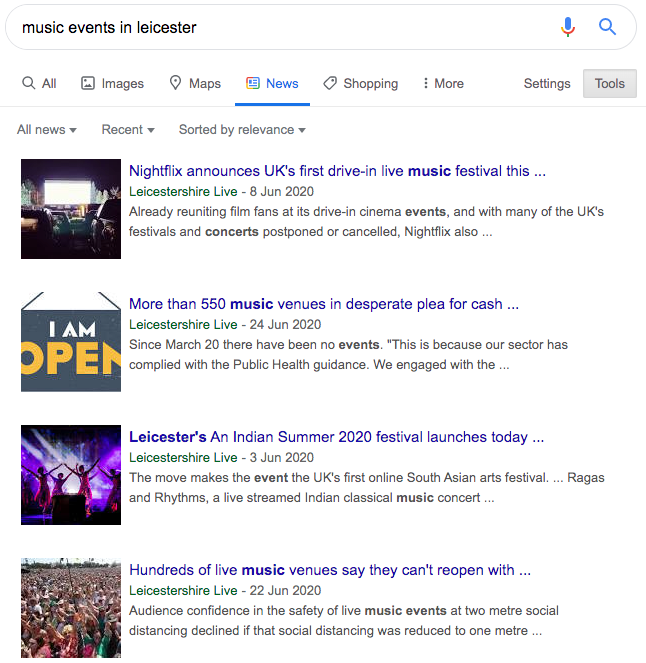
You’d likely have the same data on a webpage, but this allows you to surface it quicker to the searcher. 


The best way to figure out what types of schema you should use is on the search gallery pag es of
Google and Bing. The most common ones are:


  • LocalBusiness/Organisation: This tells Search Engines facts about the business, such as hours they’re open, address, phone numbers and more
  • FAQs: A list of questions and answers about the website or content on the page
  • Product: This is great for eCommerce websites, where products are marked up with the price, quantity in stock, reviews and other important details
  • Breadcrumbs : Breadcrumbs give search engines a better way to understand how a specific page fits into the overall structure of the website


How to implement Scheme Markup on a website 


You should follow these steps to understand how to implement schema markup:


  1. Understand the type of data you can represent on a webpage with schema
  2. Use a tool to generate the schema markup
  3. Embed the schema markup on that specific page
  4. Test it with Google or Bing structured data testing tool 


So that’s the overview; here are the details...


The first thing to understand is the type of data you can represent with schema. I recommend you browse through
Google’s gallery of supported types to find one that matches. Note that schema should only be implemented on a single page and any schema you implement should represent something that is displayed on the same page.

After you know what type of schema you want to implement, we recommend using a tool to generate the schema markup. 


Note about schema flavours or vocabulary: There are different ways to represent schema like RDFa, Microdata and LD+JSON. We recommend you focus only on LD+JSON because it’s the easiest to read and update. It’s also the most modern.


Here’s a rundown of different tools to use:   


Google’s Structured Markup Helper:

This tool allows you to choose the type of schema you want to create and then helps you visually select the data from the webpage you want to grab it from. This is great if the website is already live and you want to simply select the data on the website. That being said, it is a bit clunky to use. 


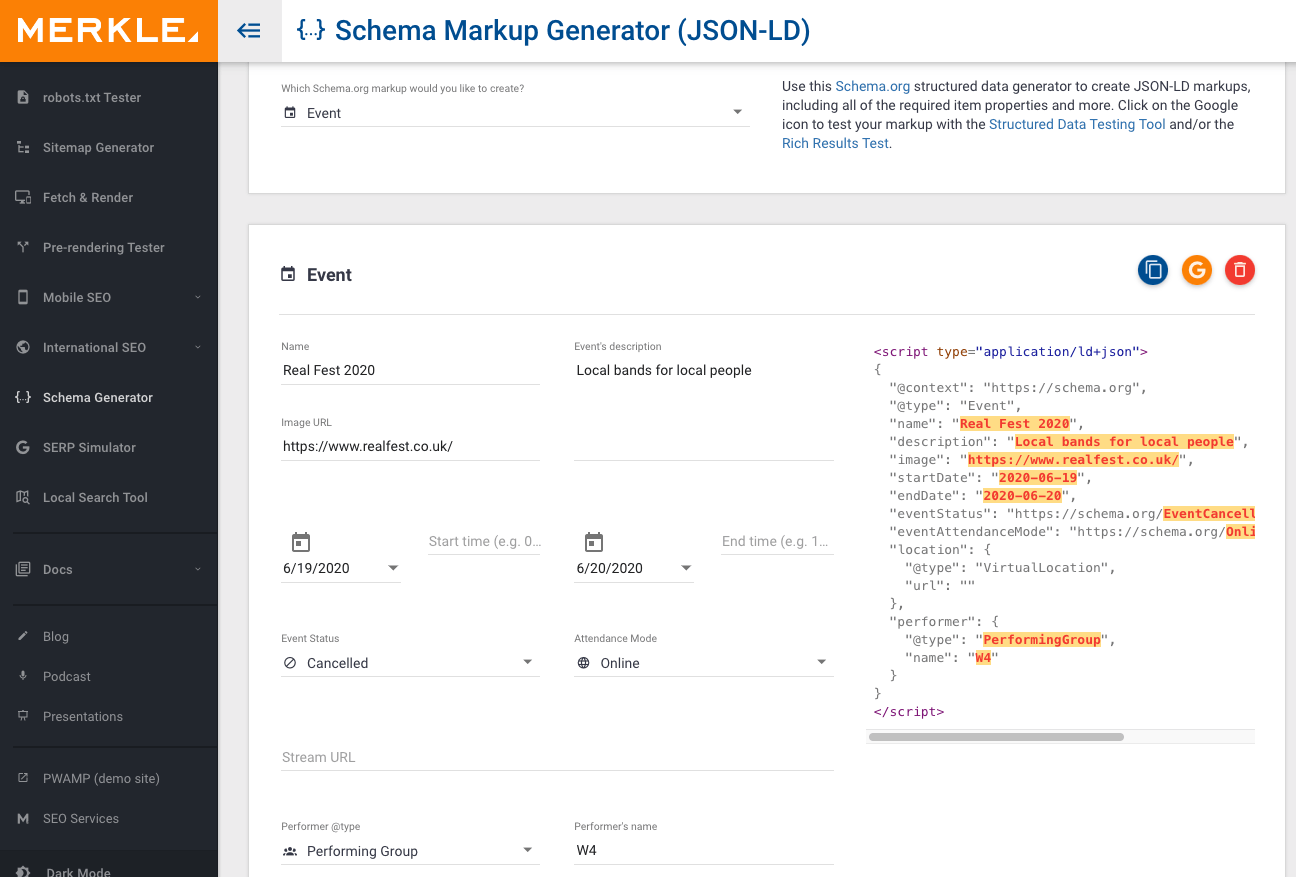
Merkle’s Technical SEO Schema Generator:

This is one of the best tools to use. You can quickly select the type of schema you want to generate and then it’s easy to use text fields to fill in that data. 


Rank Ranger’s Schema Generator:

This is another simple tool to generate a schema quickly by entering a range of text input boxes. 


After you’ve selected the type of schema you want to use and filled in the correct data, they give you an option to copy the code. This code embed will need to be placed directly into your website platform. Here’s an example of filled-in ‘Local Business’ data and the generated schema code:
After you’ve copied the code, you’ll want to embed this within a web page of your website. You can do this by logging into your website platform and including it in the page's markup, typically in the header or footer HTML section. 


It should be noted that each website platform is different. It does not matter where on the page you place the code, such as in the header or footer.


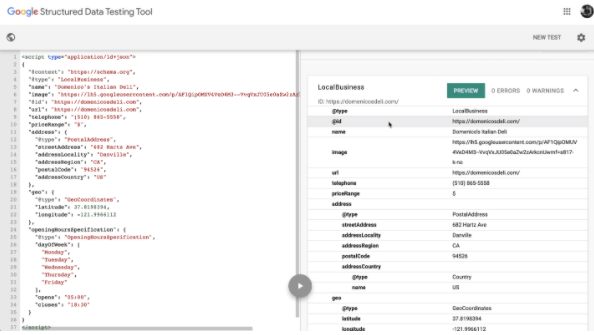
After you’ve installed the schema markup, publish or deploy the changes and test them. You can test with
Google’s Structured Data testing tool by entering the exact page URL and having Google find the schema they see.
SEO is a complex subject that's only becoming more complicated. I hope you've found these tips useful for preparing your website for the increasingly structured-data world.
Two men reviewing a computer screen in an office; one points, smiling.
By Peter Jones November 20, 2025
If you've ever felt the friction in a sales call when the topic turns to price, you're not alone. In the digital agency world, we're not just selling a product; we're selling a complex, high-value service.  How we package that service financially can be the single biggest factor in either building a partnership or hitting a brick wall. There isn't a single, one-size-fits-all approach. The truth is, the "best" model is the one that prioritises the client's immediate needs first, paving the way for a long-term, successful relationship. But this isn't just about how you price your services to your end-client. It's about the very structure of your agency. We see it all the time: talented WordPress agencies who are structured to only handle huge website builds, forcing them to turn away smaller, high-potential clients. We speak with exceptional branding agencies that want to offer a holistic service but find that building and supporting websites distract from their core expertise. This is where rigidity in your business model, not just your sales process, can cost you a perfect-fit client. The "Partnership-First" Approach to Pricing At KangarooUK , we’ve found that true success comes from seeing pricing not as a barrier, but as the first opportunity to build trust. This philosophy operates on two levels: For Direct Clients: Tailoring the payment model to demonstrate we are a partner invested in their success, not just a one-off provider. For Agency Partners: Acting as a specialist partner to help them say "yes" to more opportunities, capturing revenue they would otherwise have to refuse. Let's break down the flexible models that build better relationships on both fronts. Part 1: Flexible Models for Your Direct Clients First, let's examine the client-facing models, even if you plan to outsource the build. Offering these options positions you as a strategic consultant. 1. The Classic: Upfront Project Fees (with a twist) This is the traditional model: the client pays for the website build as a defined project. The Risk: A 100% upfront fee is a deal-breaker for many SMEs with tight cash flow. It can also frame the relationship as purely transactional. The project ends, you hand over the keys, and the partnership struggles to evolve into an ongoing retainer. The Smart-Flex: This is where milestone payments shine. For example, a 50% deposit to secure the project and commence design, with the final 50% balance due just before the new, conversion-driven website goes live. This is a powerful trust-builder. 2. The Relationship-Builder: The 12-Month Split Another highly effective, customer-centric model is splitting the website build cost over 12 months. This model is a game-changer for clients who need to manage their budgets predictably. It transforms a large, daunting capital expense (CAPEX) into a manageable monthly operational expense (OPEX). It’s flexible, predictable, and deeply appreciated by businesses that need to align their outgoings with their revenue. For the agency, it secures a 12-month commitment, naturally opening the door to bundling ongoing marketing retainers. 3. The All-In Partner: "Free" Site + Marketing Retainer This model takes the 12-month split a step further, rolling the entire cost of the build into a 24 or 36-month marketing retainer, presenting the website itself as "free." This is the ultimate low-barrier-to-entry model, powerfully attractive to new businesses. It positions you as a long-term partner from day one and secures predictable, long-term Monthly Recurring Revenue (MRR). Part 2: The Ultimate Flexibility: The Agency-to-Agency Partnership The models above are great, but what if the project itself doesn't align with your agency's needs? What about the client who needs a site, but your minimum project fee is too high? Or the client who needs a fast, scalable site on a platform you don't specialise in? This is where true flexibility wins. Instead of saying "no," you say, "Yes, we can handle that." As the UK’s only Duda Expert & Solution Partner, KangarooUK is built to be this partner for you. We work with clients, agencies, SaaS providers, and trade associations to deliver powerful websites and advanced functionality, allowing you to scale your services without the overhead. Here’s how a partnership model enables you to perform at scale: 1. White-Label Duda Development You can offer our services under your own name. We provide fully White-Label Duda Development in your own environment and brand, enabling you to expand services, clear backlogs, or roll out hundreds of client sites discreetly. With NDAs and silent partnerships, you keep full client ownership while we provide the technical power. This is the perfect solution for branding agencies that want to offer top-tier web design without an in-house development team. 2. Seamless Migrations to a Better Platform Many clients are stuck on slow, insecure, or hard-to-manage platforms like WordPress, Wix, or Mono. A partnership allows you to offer a high-value migration service. We migrate websites to Duda with minimal disruption, whether it's one site or thousands. Every migration is SEO-conscious, ensuring your client keeps their rankings while gaining a faster, safer, and more reliable platform—which you can then manage for them on a retainer. 3. Unlock Enterprise-Grade Tools Our Custom Plan Enablement Platform gives your agency access to Duda’s most powerful features—normally reserved for enterprise plans. You can integrate external datasets, manage an unlimited number of team members, and provide clients with a fully white-labelled environment featuring SSO and API access. This allows you to compete at an enterprise level without the enterprise overhead. 4. Advanced & Custom Solutions on Demand What about the client who needs a custom price calculator, a complex API integration, or even a mobile app? You don't need to build a new department. We handle the heavy lifting. Our team delivers secure, scalable solutions—from custom widgets to database solutions and mobile app builds—that work seamlessly for your client, under your brand. How to Choose the Right Model The secret isn't having a rigid price list. It's using your discovery phase as a diagnostic tool. When you get to the budget conversation, you're not a salesperson; you're a solutions consultant. Ask the right questions: "What's your current budget, and how flexible is it?" "Are there any financial deadlines or fiscal-year considerations we need to be aware of?" "What's more comfortable for your cash flow: a one-off project investment or a predictable monthly cost?" "Are you looking for a long-term partner to help you grow?" And most importantly, ask yourself: "Is this project a perfect fit for my core team, or could I deliver a better, more profitable result for both my client and my agency by using a specialist partner?" The Key Takeaway Being customer-centric and transparent about pricing isn’t just good for clients—it’s essential for agency health. When you tailor your approach, you build immediate trust. But true, sustainable flexibility comes from having the right partners in your corner. It allows you to offer flexible pricing (like the 12-month split) on a platform built for speed and reliability. It allows you to say "yes" to projects your old model would have forced you to refuse. At the end of the day, it’s not about which model is “right” in theory. It’s about which model—and which partner—solves the client’s entire problem.
Stack of coins on top of a financial chart, with a loose coin on the bottom right.
By Peter Jones October 29, 2025
Discover how we achieved explosive growth for our clients during the Prime Big Deal Days 2025.
Screenshot of a performance dashboard showing website clicks, impressions, CTR, and position.
By Devanshi September 26, 2025
In October 2025, Google will update its Google Ads Misrepresentation Policy, specifically targeting dishonest pricing practices.
Amazon Prime box on a textured ground, black tape with logo.
By Abhilav September 24, 2025
Amazon Prime deals in 2025 bring higher fees, new strategies, and bigger opportunities for sellers during Prime Day and October’s Big Deal Days.
Show More