Why Duda for SaaS Platforms and Agencies Building Sites at Scale
Duda is a managed, white-label website builder hosted on AWS that helps software companies and agencies launch customer websites rapidly. Through custom Duda solutions for SaaS platforms and agencies, product teams embed branded site builders without taking on heavy infrastructure maintenance.
- Launch an embedded website builder or white-label website offering using Duda's REST API, single sign-on, niche templates, and AI site generation.
- Avoid third-party plugin patching and lengthy in-house builds by relying on Duda's managed AWS hosting and strong Core Web Vitals performance.
- Know the boundaries upfront: teams requiring self-hosted source code should consider other options, while platforms seeking integration support can scope requirements cleanly before building.
Why should SaaS platforms and agencies build customer websites on Duda?
Duda enables SaaS platforms and agencies to launch branded customer websites at scale through REST APIs, single sign-on, industry templates, and managed AWS hosting. This avoids lengthy internal engineering builds and plugin upkeep, though product leaders must still check whether a hosted architecture fits their technical roadmap.
Understanding what sits on the platform versus what stays inside your core software makes that architecture decision straightforward. Duda handles front-end rendering, responsive layouts, SSL certificates, backups, and global hosting, while your product remains the system of record for user accounts, billing, and business data.
Adding native websites lets SaaS companies capture customer demand inside their own product rather than sending users away to third-party builders. For digital agencies and SaaS companies, the same white-label infrastructure turns bespoke site delivery into a repeatable, commercially scalable service line.
What types of website products can you build on Duda?
SaaS companies and agencies can build embedded instant site builders, white-label client portals, and multi-tier DIY or done-for-you website services on Duda. Each model runs under your own brand domain, letting customers edit approved sections themselves or rely on a managed delivery team. We can also build vibe websites and have Duda’s AI Copilot to help with any site amends
Inside a software platform, an embedded website builder pulls live customer records from your database during onboarding and generates a ready-to-publish website in minutes. Users stay inside a familiar interface with your branding, colours, and support links rather than juggling separate logins across disconnected tools.
KangarooUK has built instant site builder workflows on Duda for SaaS platforms including Tenant, Uplisting, and BeFirst.
Agencies and saas companies and vertical industry bodies use the same foundation to launch a white-label website offering tailored to a single sector. A controlled suite of industry templates lets smaller clients self-serve on an entry tier while higher-value accounts upgrade to a done-for-you build with ongoing digital marketing support.
How do embedded websites create recurring revenue and reduce churn?
Embedded websites generate recurring revenue by turning a customer's public web presence into a paid product tier, onboarding upgrade, or premium add-on inside your software. Connecting lead capture, bookings, and customer profiles directly to your platform also makes switching away significantly harder for subscribers.
Service-based customers often sign up to vertical SaaS platforms needing a professional online presence quickly, alongside tools for CRM, review requests, and social media management. Offering DIY and done-for-you websites from one login lets you package digital growth in a way that fits your existing subscription pricing.
When a customer's live website, lead forms, and payment workflows run through your platform, your software shifts from an optional tool to daily commercial infrastructure. SaaS companies and member associations see the same retention benefit, helping new members stand out online while giving existing members measurable marketing results.
Which Duda platform features make it practical to scale to thousands of sites?
Duda scales reliably to thousands of sites by combining a comprehensive REST API, full white labelling, industry-specific templates, AI site generation, and AWS managed hosting inside one environment. Getting full commercial value from those capabilities depends on wiring data syncs and permissions cleanly from day one.
Poorly planned provisioning scripts or overly loose editor permissions create support overhead as site numbers climb. Mapping out which fields populate automatically from your application and which elements customers can edit themselves keeps every new site fast, consistent, and on-brand.
High-volume website delivery works only when every repeatable task is automated through templates and APIs rather than manual build steps. Duda is engineered specifically for multi-site platforms and agencies rather than one-off site builds, so multi-tenant controls sit at the core of the system.
How do Duda's API, white labelling, templates, and AI tools work together?
Duda's REST API, white-label editor, niche templates, and AI tools work together as an automated provisioning pipeline from sign-up to live publication. Your software triggers site creation programmatically, populates business details automatically, and hands the customer a branded editing experience with zero manual setup.
A well-structured B2B SaaS Duda platform integration links your sign-up forms, billing events, and customer records directly to Duda's Content Library. Industry-specific templates come pre-built with conversion-focused calls to action, clean SEO structure, and optional eCommerce, booking, or membership features, while custom Duda widgets and interactive tools extend functionality to match your sector.
Duda's AI capabilities, including Duda Vibe for plain-English AI editing and rapid site generation, speed up initial drafting and routine copy updates without breaking layout guardrails. Customers can refine text or pages under your brand while your team keeps full oversight of global design quality.
What technical capabilities and code integrations does Duda support?
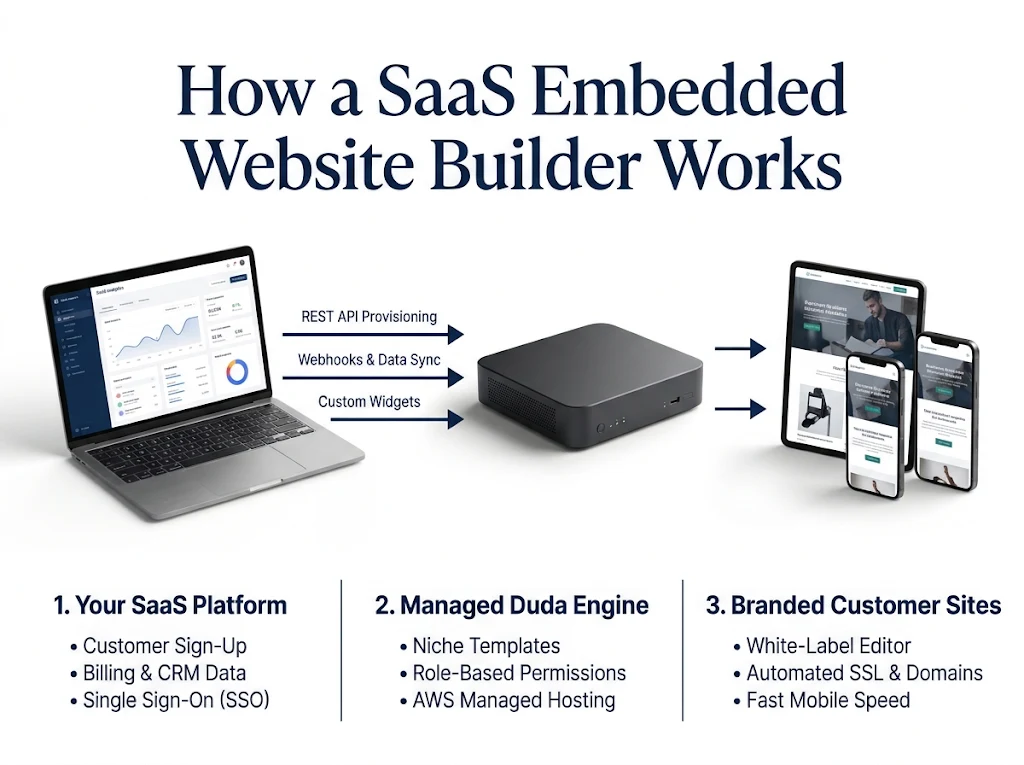
Duda supports two kinds of custom development. Inside the platform, the Widget Builder lets developers create bespoke HTML, CSS and JavaScript widgets that editors can configure without code. Outside it, Duda's External Apps let teams use modern frameworks such as React and TypeScript. Both sit on top of Duda's REST API, webhooks, single sign-on and granular role-based permissions, with customer sites hosted on managed AWS infrastructure. This lets engineering teams bring live SaaS application data into customer websites without managing the hosting behind them.
Speed and uptime directly shape customer satisfaction when you host sites at scale. Figures from the HTTP Archive Web Almanac 2025(published January 2026) show that only 48% of mobile websites across the wider web passed all three Core Web Vitals checks, with Largest Contentful Paint passing on just 62% of mobile sites.
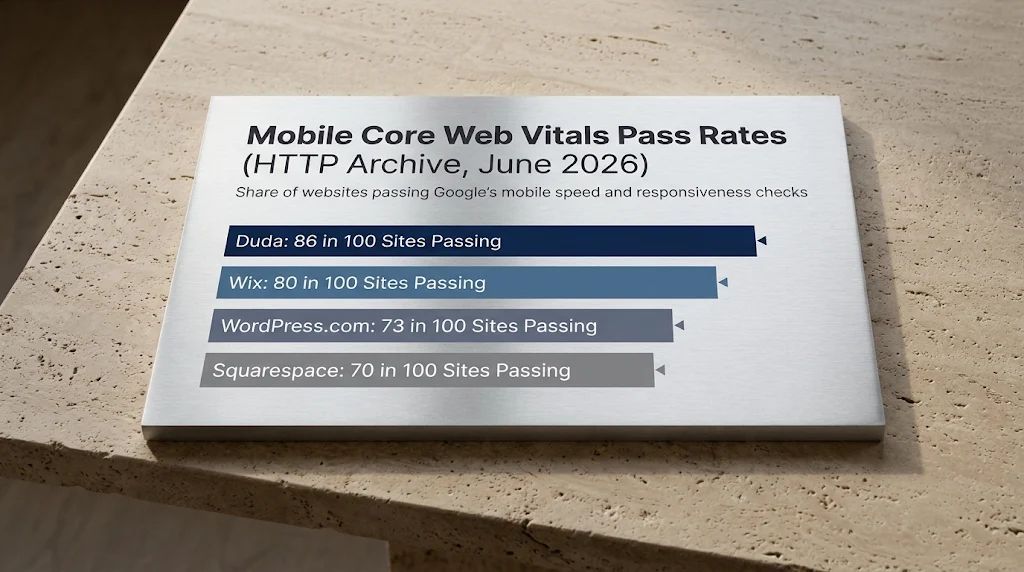
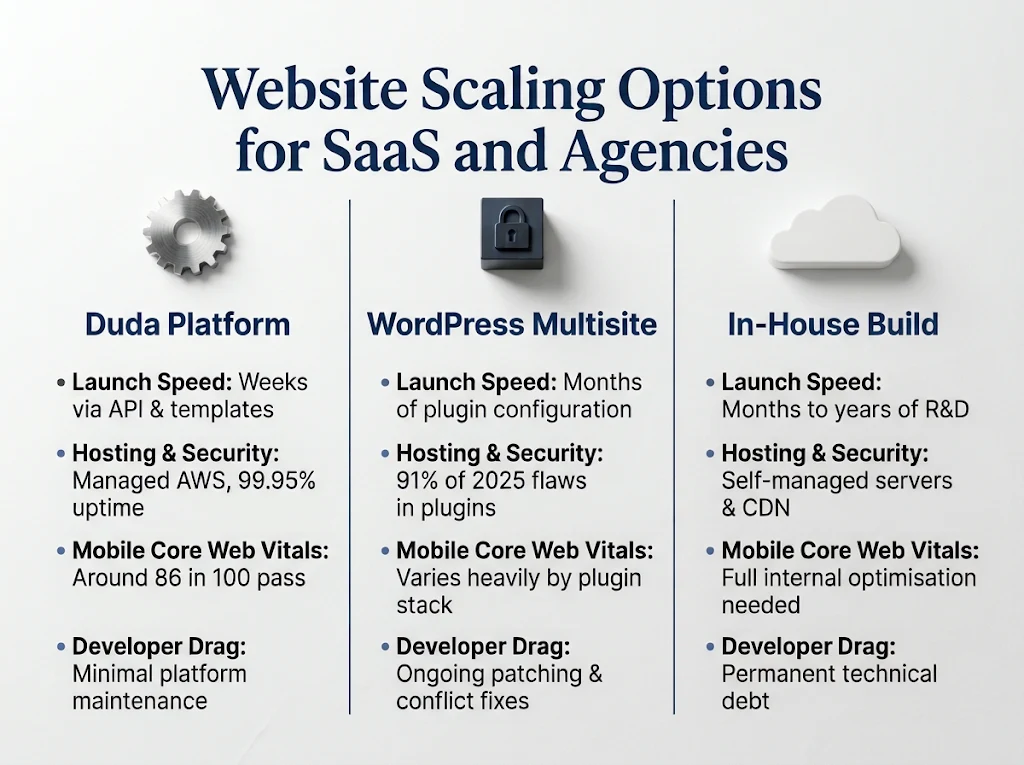
By contrast, KangarooUK builds over 90% of its websites on Duda and manages around 300 active Duda websites in-house as the UK's only certified Duda Expert and Solution Partner(one of seven worldwide in the August 2026 Duda Expert Partner Directory). That operational stability aligns with June 2026 Google HTTP Archive data showing around 86 in every 100 Duda websites passing mobile Core Web Vitals checks (compared with 80 in 100 on Wix, 73 in 100 on WordPress.com, and 70 in 100 on Squarespace), backed by Duda's AWS hosting specification of 99.95% uptime.
The technical checklist below outlines the core integration points available to SaaS engineering teams and agencies:
- Can you build custom apps inside Duda? Yes. We build custom apps that run inside your Duda pages using Duda’s External Apps feature. This allows us the freedom to use powerful frameworks like React, Typescript etc and pair it with the convenience and reliability of Duda.
- Can we add our own widgets to Duda? Yes. We build internal custom widgets in Duda’s Widget Builder. Each widget has configurable settings your team can change in the Duda editor, with no code needed. Widgets pull live data from your platform through a secure server proxy, so your API keys never appear in the page. We test every widget in a local preview of the site before it goes live.
- Can Duda sites stay in sync with our platform? Yes. We connect your platform to the Duda API, so your customer data flows into Duda Collections (its built-in data tables) and the Content Library. One template can then power many customer sites, each showing its own data, with no rebuilds.
- Can our users log in to Duda from our platform? Yes. We set up single sign-on (SSO), so your users go straight from your platform into the Duda white-label editor without a second login. We also control what each user can change, including design, content, blog, SEO and publishing.
- Can Duda connect to our CRM and billing systems? Yes. We use webhooks, which are automatic alerts Duda sends when something happens. They pass events like site publishes and form submissions to your CRM, billing or onboarding tools, so your records stay up to date without manual copying.
- Who handles domains, security certificates and hosting? Duda hosts every site on AWS, with global fast delivery and backups included. We automate custom domains and SSL certificates (the padlock that keeps sites secure), so new customer sites go live without manual setup.
- How do you make sure changes are safe to release? Every custom widget goes through an automated release process with separate development, test and live environments. Nothing reaches your customers’ sites until it has been tested and approved.
- How do you use AI in Duda builds? We use powerful AI tools to speed up development, code reviews and testing, which helps you launch sooner. We also use MCP (Model Context Protocol, a standard way for AI tools to work with other software) to connect AI directly to Duda, Figma and our project tools. The workflow is always a “human sandwich”, with real experienced developers on each side of the AI tools, maintaining integrity. We also help your editors get the most from Duda’s built-in AI for writing content and setting up widgets.
- Can AI tools connect directly to Duda using MCP? Yes. Duda offers a native Model Context Protocol (MCP) server built on its Partner API, allowing MCP-compatible AI assistants such as Claude and ChatGPT to connect securely to your Duda environment without custom glue code. Through Duda's MCP server, teams can manage websites, update collections and the Content Library, publish blog posts, edit page elements, manage user accounts and SSO links, and work with Duda Vibe sites using natural-language prompts, with human verification kept in place before changes go live.
- Want to see what’s possible for your platform? Book a technical discovery call with our development team.
Why is Duda a stronger option than WordPress multisite or building in-house?
Duda reduces ongoing engineering overhead compared with WordPress multisite and in-house builders by removing plugin patching, server management, and editor maintenance from your roadmap. Product teams launch a commercial website offering in weeks rather than years, although calculating the true long-term cost difference requires looking beyond initial build estimates.
Most founders underestimate the compounding drag that arrives twelve months after launch. Keeping a visual editor compatible with browser updates, mobile layouts, accessibility rules, and security advisories absorbs developer hours every single sprint, pulling capacity away from the core product customers actually pay for.
How does Duda compare with WordPress multisite for high-volume hosting?
Duda outperforms WordPress multisite for high-volume commercial hosting by eliminating third-party plugin dependencies, database bottlenecks, and manual security patching across hundreds of customer sites. Because updates roll out centrally on managed AWS servers, a single conflicting extension cannot take down an entire network.
WordPress core is mature, yet multi-site commercial setups almost always rely on a stack of third-party plugins for page building, forms, SEO, caching, and permissions. According to Patchstack's State of WordPress Security in 2026 report, 91% of new WordPress vulnerabilities identified in 2025 sat in plugins, with 46% unpatched at public disclosure and a five-hour median time to mass exploitation for heavily targeted flaws.
Running a WordPress multisite network at SaaS scale turns your engineering team into a permanent security and plugin-compatibility desk. Duda provides native hosting, SSL, backups, and automatic platform updates out of the box, letting KangarooUK and your internal team focus on conversion features rather than emergency patching.
Why do most SaaS teams avoid building a website builder in-house?
Most SaaS teams avoid building a website builder in-house because engineering a responsive drag-and-drop editor, template engine, CDN layer, and SEO framework diverts months of senior developer time from core product features. Ongoing maintenance then creates permanent technical debt that slows future software releases.
Every extra subsystem added to a SaaS codebase carries an ongoing maintenance tax. Data from the Stack Overflow 2024 Developer Survey shows that 63% of professional developers cite technical debt as their top frustration at work, ahead of tooling complexity and deployment friction.
Building a proprietary site editor rarely differentiates a vertical SaaS product, because customers expect modern website basics as standard rather than novel software IP. Licensing Duda's mature editor and connecting it via API lets your developers concentrate on the domain-specific workflows that actually win accounts. Just as importantly, Duda handles managed hosting, SSL certification, automated backups, and automatic platform updates out of the box, removing a major operational burden that an in-house build would leave your team maintaining permanently.
When is Duda not the right fit, and how can a specialist partner help?
Duda is not the right fit for SaaS companies that must self-host all front-end source code on private infrastructure or run bespoke server-side web applications inside the CMS. Knowing where those platform boundaries sit prevents expensive rework before a single line of integration code starts.
An honest pre-build assessment saves months of friction later. Weighing your compliance rules, data residency obligations, and custom application logic against Duda's hosted architecture clarifies immediately whether Duda should power the public website layer while your own cloud stack handles complex transactional software. That boundary is changing soon, as Duda is working on a backend solution that has not yet launched, and we will update you once it goes live.
When should a SaaS company or agency choose an alternative to Duda?
SaaS companies and agencies should choose an alternative to Duda if they require full self-hosted source code ownership, on-premise deployment inside a private cloud, or deep server-side application logic built directly inside the website CMS. In those cases, a headless or custom-engineered framework fits better.
Duda is a closed, cloud-hosted SaaS platform on AWS, which is precisely why it delivers high uptime and low maintenance, yet that same architecture means you cannot export and self-host its underlying editor code. Organisations operating under strict air-gapped or sovereign on-premise hosting mandates should also evaluate self-hosted options.
The smartest architecture for many software companies is hybrid: keep complex authenticated application logic in your own SaaS stack, and let Duda power fast, marketing-ready customer websites. Complex functionality can still live seamlessly inside Duda templates through bespoke custom widgets and external apps, which we engineer to run reliably at production scale. Where a requirement genuinely sits outside what a cloud-hosted builder is designed for, such as self-hosted source code or private on-premise infrastructure, an experienced partner will tell you upfront rather than forcing the wrong tool for the job.
"SaaS founders come to us wanting to give their customers websites without turning their own developers into a web agency. Nine times out of ten, Duda handles a lot of the heavy lifting through its API, white-labelling, and custom widgets, and if a requirement genuinely belongs in full-stack custom code rather than Duda, we will tell you upfront before you spend a penny on development." - Macauley Smith, Head Developer
How does KangarooUK support SaaS integrations and agency rollouts?
KangarooUK supports SaaS platforms and agencies through technical discovery workshops, bespoke API and SSO integrations, custom widget engineering, niche template systems, and white-label developer capacity. Our UK-based specialists also troubleshoot, improve, and extend existing Duda workflows, including integrations originally built by another developer or agency.
Most software leaders start with a fixed-price Duda Discovery Sprint(£500 + VAT) to validate API architecture, data syncs, and commercial packaging before committing to a full build. Agencies and internal product teams needing extra engineering capacity without hiring full-time specialists can also hire a dedicated Duda developer on flexible white-label terms.
From our headquarters in Ashby-de-la-Zouch, KangarooUK pairs every partner with a named UK specialist backed by global Duda engineers, eliminating ticket queues and jargon. Whether you are launching an embedded website builder from scratch or fixing a third-party provisioning flow, you get clear scoping and ongoing maintenance contracts.
Frequently asked questions about Duda for SaaS and agencies
Can customers edit their Duda websites inside our SaaS platform without a separate login?
Yes. Duda supports Single Sign-On (SSO) and full white labelling, allowing your SaaS users to move straight from your application dashboard into their branded website editor without creating separate passwords. Granular role-based permissions let you control exactly which sections, pages, and publishing settings each user can change.
Do we need an internal development team to launch a Duda website offering?
No, you do not need dedicated in-house Duda developers to launch an embedded website builder or white-label website offering. Your core engineers only need to expose the relevant API endpoints or webhooks from your SaaS platform, while a certified Duda partner handles templates, custom widgets, and provisioning workflows.
Can KangarooUK improve or fix an existing Duda integration built by another developer?
Yes. KangarooUK works directly with SaaS businesses and agencies to audit, repair, and extend existing Duda workflows, even when another developer built the original setup. Whether you need minor logic tweaks, smoother data syncs, or new upsell flows, our team resolves issues quickly.
How do we scope and budget a Duda SaaS integration before committing to a build?
The lowest-risk first step is a fixed-price Duda Discovery Sprint with KangarooUK at £500 + VAT. During the sprint, our technical specialists map your API connections, template requirements, SSO permissions, and custom widget scope into a clear architecture plan and costed roadmap before full development begins.
Ready to explore an embedded website builder or white-label website offering on Duda? Book a technical discovery call with the KangarooUK team or call us directly on 01530 560177 to discuss your architecture, templates, and integration roadmap.