

What is AEO? The Complete Guide to Answer Engine Optimisation for 2026
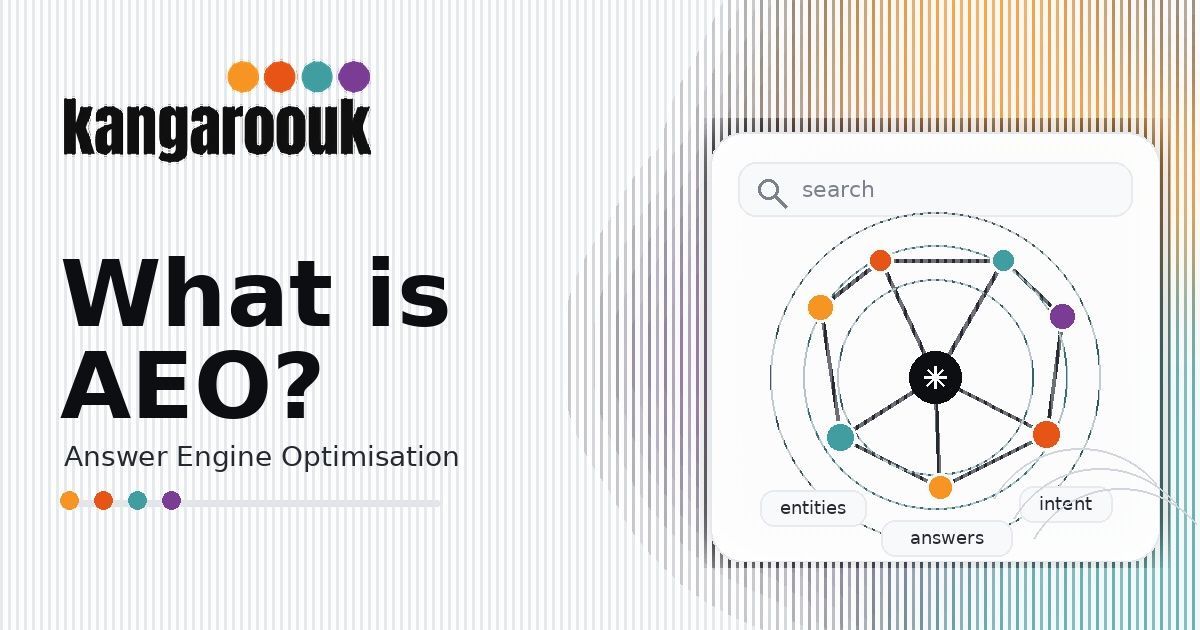
Answer Engine Optimisation (AEO) is the practice of creating content that AI systems can extract, cite, and present as direct answers to user queries. It's the evolution of SEO for an age where the majority of Google searches end without a click – because the answer appears directly on the results page.
If you're still optimising solely for traditional search rankings, you're missing a fundamental shift in how people find information. This guide explains what AEO is, why it matters for your business, and how to start optimising your content today.
Download the Complete AEO Content Guide
We've compiled everything in this article (and more) into a comprehensive 20-page guide your team can use. Includes checklists, schema templates, and practical examples.
Why Should You Care About AEO?
The numbers tell the story. According to research compiled by CXL and industry analysts:
• 65% of Google searches now end without a click to any website
• Over 400 million people use ChatGPT weekly for information
• Google's AI Overviews appear in 13-16% of all searches
• Gartner predicts 25% of organic search traffic will shift to AI assistants by 2026
This isn't a temporary trend. Voice assistants, AI chatbots, and Google's own AI features are fundamentally changing how people get answers. They don't want ten blue links – they want one clear answer.
The question for your business is simple: when someone asks an AI system about your services, your industry, or the problems you solve, will your content be the source it cites?
What's the Difference Between SEO and AEO?
Traditional SEO focuses on ranking your pages higher in search results. The goal is to earn the click – get users from the search page to your website.
AEO takes this further. The goal isn't just to rank; it's to become the answer that AI systems extract and present directly. Your content might be cited in:
• Google AI Overviews (the AI-generated summaries at the top of search results)
• ChatGPT, Claude, and Perplexity responses
• Voice assistant answers from Siri, Alexa, and Google Assistant
• Featured snippets and knowledge panels
The shift is from 'get the click' to 'be the answer'. Even if users never visit your website, your brand becomes the trusted source.
This doesn't mean SEO is dead – far from it. AI systems still rely on traditional search indexes to find content. If your pages aren't indexed and ranking, AI won't find them either. AEO builds on SEO fundamentals with additional focus on how content is structured and presented.
How Do AI Answer Engines Actually Work?
Understanding the mechanics helps explain what we need to do differently.
AI systems like ChatGPT and Google's Gemini work in two ways:
1. Training Data
Large Language Models are trained on massive amounts of text scraped from the web. This gives them general knowledge, but it has a cutoff date and can contain errors.
2. Real-Time Search (RAG)
To provide current information, AI systems query traditional search engines and incorporate those results into their responses. This is called Retrieval-Augmented Generation. As Duda's research explains, when you ask ChatGPT about recent news or current prices, it searches the web in real time and synthesises the results.
This means your content needs to be:
• Indexed by search engines (so AI can find it)
• Clearly structured (so AI can extract relevant snippets)
• Authoritative (so AI trusts it enough to cite)
How to Optimise Your Content for Answer Engines
Research from Princeton University tested various optimisation techniques and measured their impact on AI citations. Their GEO (Generative Engine Optimization) study found that certain approaches significantly improved how often content was cited. Here's what works:
Lead With the Answer
Don't bury your main point under lengthy introductions. State your answer clearly in the first 40-60 words, then elaborate. AI systems extract snippets – make sure yours contain the actual answer.
Add Statistics and Citations
The Princeton research found that adding statistics, quotes, and citations improved AI visibility by 30-40%. This makes sense – AI systems are looking for authoritative, verifiable information.
Use Question-Based Headings
Structure your H2s as questions that match what people actually ask. Instead of 'Pricing Information', use 'How Much Does Web Design Cost?' This directly aligns your content with search queries.
Make Each Section Self-Contained
AI extracts content at the section level. Each section should make sense on its own, without requiring context from elsewhere on the page.
Be Specific, Not Vague
'We use Screaming Frog, Ahrefs, and Google Search Console' is more useful than 'industry-leading tools'. 'Based in Leicestershire, serving clients across the UK' beats 'our area'. Specifics build trust.
The Role of Schema Markup and Structured Data
Schema markup is how you explicitly communicate information to search engines in a format they can easily parse. It's particularly important for AEO because it helps AI systems understand:
• What your business is (Organisation, Local Business schema)
• Who your experts are (Person schema for authors)
• What your content covers (Article, FAQ Page schema)
• What you sell (Product, Offer schema)
Research suggests pages with comprehensive schema markup are 36% more likely to appear in AI-generated summaries. However, schema is a supporting element; it can't compensate for thin content.
Schema markup is Medium priority: helpful where appropriate, but only implement it if you know it will help. Don't add it just to tick a box.
What About E-E-A-T?
Google's E-E-A-T framework (Experience, Expertise, Authority, Trustworthiness) is more important than ever for AEO. AI systems need to determine which sources to trust and cite.
In practice, this means:
• Show real experience – include examples from actual projects, not theoretical advice
• Demonstrate expertise – technical depth, named authors with credentials
• Build authority – get cited by other reputable sources, maintain consistent entity information
• Establish trust – cite your sources, be transparent, keep content accurate and current
The businesses that will win in AEO are those that genuinely know their subject and can demonstrate it through their content.
Get the Full Implementation Guide
Our complete AEO Content Creation Guide includes detailed checklists for every page type (service pages, blogs, local pages, product pages), schema markup templates, and a priority framework for technical optimisation.
Technical Priorities: What Actually Matters
Not all technical elements are equally important. Based on guidance from Duda's SEO team and our own experience, here's how to prioritise:
Critical: Indexability
If search engines can't crawl and index your content, AI systems can't find it. Check your pages aren't blocked by noindex tags or robots.txt. This is the foundation.
High Priority: Title and Meta Description
Unique, descriptive titles (50-60 characters) and compelling meta descriptions (150-160 characters) are still crucial signals.
Medium Priority: Supporting Elements
Schema markup, clear URL structure, page speed, sitemaps. These help where appropriate but aren't make-or-break.
Lower Priority: HTML Hierarchy
Proper H1/H2 structure and breadcrumbs are nice to have, but don't obsess over them at the expense of content quality.
The key insight: brilliant content with basic technical optimisation will outperform thin content with perfect technical setup every time.
How to Measure AEO Success
Traditional metrics like rankings and traffic don't tell the whole story. For AEO, you also need to track:
• Brand mentions in AI Overviews (manual checks for your key queries)
• Citations when you search your topics in ChatGPT, Perplexity, Claude
• Featured snippet appearances
• Knowledge Panel presence (search your brand name)
Until better tools emerge, we recommend monthly manual testing: identify your 10-20 most important queries, test them across AI platforms, and document whether you're being mentioned, cited, or linked.
Ultimately, though, the metrics that matter are business outcomes: leads, conversions, and revenue. AEO is a means to that end, not an end in itself.
Getting Started: Your Next Steps
You don't need to overhaul everything at once. Start here:
1. Audit Your Most Important Pages
Pick your top 5 service pages or blog posts. Do they answer specific questions clearly? Is the answer in the first paragraph? Are claims backed by data or examples?
2. Check Your Technical Foundation
Make sure those pages are indexable, have unique titles and descriptions, and load quickly on mobile.
3.
Test Your AI Visibility
Search for your key topics in ChatGPT and Google. Are you being cited? Are your competitors? This tells you where you stand.
4.
Improve One Page at a Time
Apply the principles from this article: lead with answers, add statistics and sources, and structure content for extraction. Measure the impact before rolling out more widely.
Download the Complete AEO Content Guide
Everything in this article, plus detailed checklists for every page type, schema markup templates ready to use, the full technical priority framework, and a list of resources for further reading. It's the guide we use internally at Kangaroo UK – and it's yours free.
Need Help With Your AEO Strategy?
At Kangaroo UK, we've been building websites and optimising content for over 8 years. We're seeing first-hand how AI is changing search, and we're helping our clients adapt.
If you'd like to discuss how AEO fits into your digital marketing strategy, get in touch. We offer SEO services that include AEO optimisation, content strategy, and technical implementation